
In 2026, successful marketplaces are defined by how well they connect order management, fulfilment and returns to deliver fast, flexible and reliable customer experiences at scale.
.png)
Online marketplaces are no longer competing on product range alone. In 2026, success is being decided behind the scenes, in how well marketplaces orchestrate orders, deliveries, and returns across increasingly complex fulfilment networks.
Customer expectations have shifted faster than traditional retail systems were ever designed to handle. Rapid delivery, multiple pickup options, fragmented returns journeys, and third-party fulfilment are now table stakes, not differentiators. The marketplaces that thrive in 2026 will be the ones that treat order management and fulfilment connectivity as core infrastructure, not an operational afterthought.
Marketplace models introduce a level of operational complexity that fundamentally differs from traditional retail. As highlighted in the 2026 Marketplace Success Strategy, online marketplaces must support:
What makes this especially challenging is that many marketplaces are still running on technology stacks originally designed for linear, single-brand retail. The result is brittle processes, manual workarounds, and poor visibility across orders and inventory. History has shown how damaging this can be. Best Buy famously shut down its marketplace in 2016, citing the operational burden of managing orders and returns at scale. In 2026, those pressures are even more intense.
Marketplace expectations are not retail expectations. Customers now assume:
When those expectations aren’t met, the impact is immediate: lost trust, increased customer service costs, and eroding margins. Orders and returns complexity doesn’t just slow growth, it actively kills marketplaces when left unchecked. This is why OMS has moved from a “back-office system” to a strategic control layer in the modern marketplace stack.
A modern Order Management System is no longer just about routing orders. In 2026, leading marketplaces are using OMS platforms to:
As Jamie Cairns, Chief Growth Officer at Fluent Commerce, puts it: “The marketplaces that will win in 2026 are those that treat order orchestration, optimised fulfilment and real-time inventory visibility as core capabilities, not an afterthought.”
Without this orchestration layer, marketplaces are forced to hard-code integrations, manually manage exceptions, and accept poor customer experiences as inevitable.
.png)
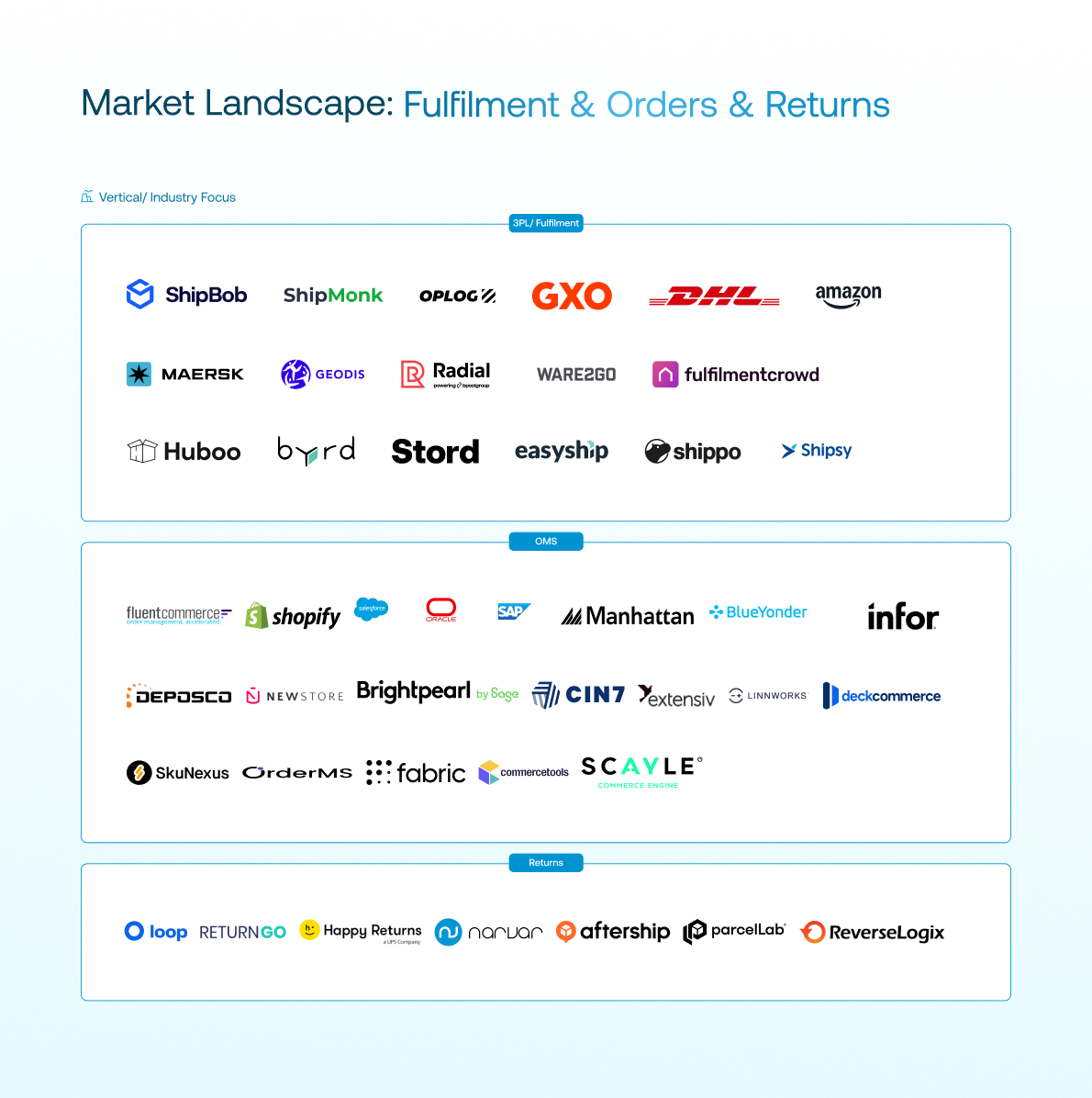
The ecosystem supporting marketplaces has matured rapidly. The current landscape spans three core pillars:
Providers such as ShipBob, GXO, DHL, Amazon, Maersk and Radial now offer global, multi-node fulfilment capabilities, but each comes with its own data models, SLAs and integration requirements.
OMS platforms like Fluent Commerce, Manhattan, SAP, Shopify, Blue Yonder and others are evolving to handle complex order orchestration, rather than simple routing.
Returns specialists including Loop, Happy Returns, Narvar and AfterShip are addressing one of the most operationally painful parts of the marketplace journey.
The challenge for marketplaces isn’t access to these tools, it’s connecting them into a cohesive, real-time operating model.
In 2026, marketplaces don’t fail because they lack technology. They fail because their systems don’t talk to each other well enough.
Disconnected OMS, fulfilment and returns platforms create:
By contrast, marketplaces that invest in deep, event-driven connectivity between their OMS and fulfilment partners unlock:
This is where integration platforms and modern middleware become foundational to the marketplace stack, not optional extras.
As we move through the rest of 2026, several trends are becoming clear:
Marketplaces that can rapidly connect new fulfilment partners, experiment with delivery models, and maintain consistent customer experiences will pull ahead, while those tied to rigid, disconnected systems will struggle to keep up.
The modern marketplace stack in 2026 is defined by connection, orchestration and adaptability. Orders, delivery and returns are no longer operational details, they are the foundation of customer trust and marketplace growth.
For marketplace leaders, the question is no longer whether to modernise OMS and fulfilment connectivity, but how quickly it can be done without disrupting the business.
